1

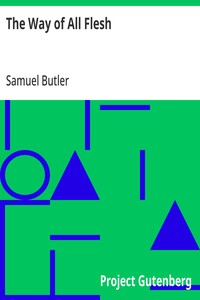
The Way of All Flesh — Text and Context
(0 User reviews)
575
Project Gutenberg
2000
Not confirmed
Autobiographical fiction; England -- Fiction; Domestic fiction; Bildungsromans; Young men -- Fiction; Children of clergy -- Fiction; Conflict of generations -- Fiction; Parent and adult child -- Fiction; Middle class -- Fiction
Readers of public-domain and historical texts
Project Gutenberg digital edition
en
Edition facts
Words
168,621
Reading time
734 min
Text sections
88
This digital edition of The Way of All Flesh — Text and Context is described by source-level measurements including 168,621 words, 12 hr 14 min estimated reading time, and 88 detected text sections.
The text analysis averages about 29.7 words per sentence, while the detected sections provide another way to judge how the source is divided.
Project Gutenberg metadata also associates the work with “Autobiographical fiction,” connecting these edition facts with the source record’s subject description.
Source:
Project Gutenberg record #2084
Samuel Butler's semi-autobiographical novel dissects Victorian family hypocrisy through the Pontifex family, using a detached narrator and sharp irony to expose the gap between pious rhetoric and emotional manipulation, particularly in parental control over children's lives.
Read the complete public-domain text at its original source.
Read on Project GutenbergThe Way of All Flesh opens with a narrator recalling an old man in knee-breeches, establishing a retrospective voice that will frame the Pontifex family saga. Butler immediately signals his interest in heredity and environment: the carpenter Pontifex, his "Gothic" wife, and their son Theobald, a clergyman whose piety masks rigidity. The preface notes the novel was written alongside Butler's Life and Habit, suggesting the fiction tests his theories of inherited traits. What follows is a clinical dissection of how parents shape—and damage—their children, rendered through precise, often sardonic observation rather than melodrama.
Narrative Distance and Ironic Control
The narrator, Overton, is a family friend who speaks from the early 1800s, creating temporal distance that allows cool judgment. He describes Theobald's father as "too good-natured to say nay to any woman who wooed him," a phrase that undercuts the patriarch's authority. This ironic tone pervades: Christina's "duty" to warn Ernest about religious doubts becomes a sleight of hand where she claims to have told him "all" while revealing nothing. Butler uses Overton's hindsight to expose the gap between characters' self-perceptions and their actual behavior, a technique that turns domestic scenes into case studies in hypocrisy.
Parental Manipulation Disguised as Concern
Christina's conversation with Ernest about becoming a clergyman exemplifies Butler's focus on emotional coercion. She frames her evasion as delicacy—"I am not fitted to enter upon either by nature or education"—while ensuring Ernest accepts orthodoxy uncritically. The narrative notes that "they were satisfied that they had done their duty," a damning verdict on their self-deception. Later, Christina pivots to Ernest's duty to find Charlotte a husband, revealing that parental "care" is often about social advancement. The repetition of such scenes builds a pattern: the Pontifex parents use religious and filial language to enforce conformity, while the narrator quietly records the damage.
The Weight of Heredity and Environment
Butler embeds his theory of heredity in the novel's structure. Old Mr. Pontifex's drawings—"unaffectedly painstaking"—suggest a latent artistry that skips a generation, emerging in Ernest. Yet Theobald and Christina actively suppress Ernest's independence, treating him as raw material for their ambitions. The narrator notes that Ernest "had heard it so often" when his mother chides him about friends, implying a lifelong conditioning. Butler does not claim determinism; rather, he shows how family patterns repeat unless broken by conscious effort. The novel's title, from Romans 8:28, is ironic: things do not work together for good for those who love God, but for those who escape familial tyranny.
Diction as a Tool of Character Revelation
Butler's characters reveal themselves through their speech. Christina's euphemisms—"a little disappointed," "not been deficient hitherto"—mask her manipulation. Theobald's authority is conveyed through reported commands, while Ernest's internal reactions are given in plain, unadorned prose: "Ernest began to chafe." The contrast between the parents' ornate, self-justifying language and the narrator's blunt assessments creates a running commentary on hypocrisy. Even minor phrases carry weight: Christina's "toss of her head" signals vanity. Butler's ear for the clichés of Victorian domestic piety—"dear, kind sister," "suitable partner"—turns dialogue into evidence of a system that prizes appearances over truth.
Readers attentive to Butler's irony will find a novel that rewards close attention to what is said and what is withheld. The excerpts offer no resolution, only the slow accumulation of pressures that shape Ernest's fate. Treat the narrator's judgments as provisional, part of a deliberate design that uses distance to critique without sentimentality. The Way of All Flesh is less a story than an anatomy of how families reproduce their flaws—and how one might begin to see them clearly.
Reading about Ernest Pontifex’s hollow Sundays, I remembered my own childhood pew—the careful, smiling silence. That weight of unspoken expectations. The House of Mirth — Background and Themes gave me the same shiver years ago, watching Lily Bart perform her grace while the room quietly devoured her. Both books made me wonder how much of what we call love is just a contract we never signed.
There are no reviews for this eBook.
There are no comments for this eBook.
Reader reflection
How will you remember this book?
Save your reaction, strongest insight, and memorable passage.
Your progress
0
/
10
2
How much did you enjoy the reading experience?
3
Would you pass this book on to a friend?
4
What was the reading difficulty like?
5
Did the book give you something worth debating?
6
How well did it match your expectations?
7
Which element worked best for you?
8
Do you expect to return to this book?
9
What is the main idea you are taking away?
10