1

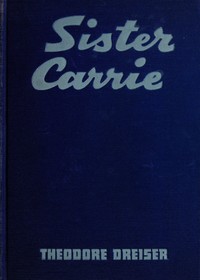
Sister Carrie: A Novel — A Reader’s Guide
(0 User reviews)
479
Project Gutenberg
1995
Not confirmed
New York (N.Y.) -- Fiction; Didactic fiction; Young women -- Fiction; Chicago (Ill.) -- Fiction; Mistresses -- Fiction
Readers of public-domain and historical texts
Project Gutenberg digital edition
en
Edition facts
Words
163,822
Reading time
713 min
Text sections
49
Sister Carrie: A Novel — A Reader’s Guide can be approached with a clearer sense of reading commitment from its source measurements: 163,822 words, 11 hr 53 min estimated reading time, and 49 detected text sections.
The text analysis averages about 12.8 words per sentence, while the detected sections provide another way to judge how the source is divided.
Project Gutenberg metadata also associates the work with “New York (N.Y.) -- Fiction,” connecting these edition facts with the source record’s subject description.
Source:
Project Gutenberg record #233
Theodore Dreiser's novel follows Carrie Meeber's journey from a small-town girl on a Chicago-bound train to a life shaped by urban forces, using chapter titles as thematic anchors and recurring images of gates, windows, and letters to chart her movement between poverty and material desire.
Read the complete public-domain text at its original source.
Read on Project GutenbergTheodore Dreiser’s Sister Carrie opens with Caroline Meeber boarding a train for Chicago, carrying a “cheap imitation alligator-skin satchel” and a “yellow leather snap purse.” From this first scene, the novel establishes a pattern of movement between interiors and exteriors, trains and streets, rooms and windows. Dreiser’s chapter titles—such as “The Magnet Attracting: A Waif Amid Forces” and “The Lure of the Material: Beauty Speaks for Itself”—function as thematic headlines, framing each section as a stage in a larger social and psychological drama.
The excerpts show Dreiser’s attention to the physical details of urban life: department stores, boarding houses, and the constant negotiation of space. Carrie’s trajectory is marked by letters, missed encounters, and the lingering presence of objects like Drouet’s umbrella and overcoat. The novel’s structure mirrors the restless movement of its characters, who are always arriving, waiting, or leaving.
Chapter Titles as Thematic Anchors
Dreiser’s chapter titles are not mere labels but interpretive guides. They pair abstract forces with concrete situations: “The Magnet Attracting: A Waif Amid Forces” introduces Carrie as a passive object drawn by unseen powers; “What Poverty Threatened: Of Granite and Brass” sets the city as a hard, indifferent landscape. Later titles like “The Lure of the Material: Beauty Speaks for Itself” and “Convention’s Own Tinder-Box: The Eye That Is Green” suggest moral and emotional flashpoints. The repetition of key phrases—ambassador, gate, tinder—creates a network of imagery that links Carrie’s personal story to larger social mechanisms. In the excerpts, the title “When Waters Engulf Us We Reach for a Star” appears at a moment of crisis, reinforcing the pattern of aspiration amid despair. These titles function as a second layer of narration, commenting on the action without interrupting it.
Recurring Images: Gates, Windows, and Letters
Throughout the excerpts, gates and windows mark thresholds between states of being. Carrie is “just over the border” in one chapter; Hurstwood searches for “the gate” in another. These are not just physical openings but symbols of opportunity and exclusion. Windows appear repeatedly: Drouet looks out at gathering clouds; Carrie’s picture hangs on the wall, her face “a little more wistful.” Letters carry emotional weight—Carrie writes a painful farewell, then drops it “reluctantly into the letter-box.” The act of writing and receiving letters becomes a way of measuring distance between characters. Dreiser uses these recurring details to create a visual and emotional geography, where every threshold implies a choice or a loss.
Movement Between Scenes: The Rhythm of Waiting and Departure
The novel’s structure is built on a rhythm of waiting, arrival, and departure. In the excerpts, Drouet waits for Carrie in her room, “trifled about, hoping that she was somewhere in the neighbourhood,” then leaves with his umbrella and coat. Carrie, meanwhile, returns “weary and disheartened” from job hunting. The scene is a study in missed connections: Drouet expects to find her, she expects him to have left. Dreiser lingers on the physical details of waiting—the rocking-chair, the lit cigar, the listening for footsteps. This pattern repeats across the novel: characters are always in transit, between trains, between jobs, between relationships. The city itself becomes a stage for these movements, with department stores, streets, and boarding houses serving as backdrops for encounters that never quite align.
The Role of Objects in Defining Character
Dreiser invests ordinary objects with emotional and narrative significance. Carrie’s initial possessions—the trunk, the satchel, the purse—define her limited means. Later, Drouet’s umbrella and light overcoat become evidence of his presence and then his absence. When Carrie discovers they are gone, she realizes “his going was crystallising into staying.” The picture of Carrie on the wall, showing her in the jacket Drouet first bought her, becomes a focal point for his rare moment of feeling. These objects are not mere props; they carry the weight of past decisions and future possibilities. Dreiser’s attention to material detail—the “cheap imitation alligator-skin,” the “yellow leather snap purse”—grounds the novel’s social commentary in tangible things, making abstract forces like poverty and desire visible in the physical world.
Readers attentive to Dreiser’s structural choices will notice how each chapter title previews a moral or emotional shift, and how objects like letters and umbrellas carry the story forward. The novel rewards attention to these recurring patterns, which give shape to Carrie’s otherwise chaotic journey. Rather than a straightforward narrative, Sister Carrie unfolds as a series of thresholds crossed and missed, each one altering the course of its characters’ lives.
That rainy afternoon I spent with Dreiser’s Carrie — her hunger for light, for windows that never quite let her in — stayed with me oddly. Her letters, paused halfway, felt like my own unfinished thoughts. Later, almost without deciding, I picked up a quieter book about longing and missed timing, and found the same ache there: The Touchstone — A Reader’s Guide. Some doors close so softly you don’t hear the click.
There are no reviews for this eBook.
There are no comments for this eBook.
Reader reflection
Record your reading impressions
A brief reflection can help important ideas stay with you longer.
Your progress
0
/
10
2
How much did you enjoy the reading experience?
3
How likely are you to recommend this book?
4
How demanding did the text feel?
5
How did the reading compare with what you expected?
6
Did the story or argument move comfortably?
7
Did any part of the book stay with you emotionally?
8
How strong was your personal connection to the text?
9
What did this book teach you most?
10