1

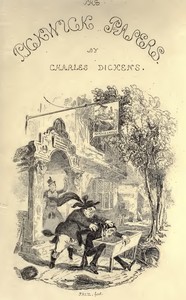
The Pickwick Papers — Context and Discussion
(0 User reviews)
229
Project Gutenberg
1996
Not confirmed
Humorous stories; England -- Fiction; Men -- Societies and clubs -- Fiction; Male friendship -- Fiction
Readers of public-domain and historical texts
Project Gutenberg digital edition
en
Edition facts
Words
313,980
Reading time
1366 min
Text sections
37
This digital edition of The Pickwick Papers — Context and Discussion is described by source-level measurements including 313,980 words, 22 hr 46 min estimated reading time, and 37 detected text sections.
The text analysis averages about 16.1 words per sentence, while the detected sections provide another way to judge how the source is divided.
Project Gutenberg metadata also associates the work with “Humorous stories,” connecting these edition facts with the source record’s subject description.
Source:
Project Gutenberg record #580
Dickens's first novel follows the Pickwick Club's travels across England, blending episodic adventures with inset tales like 'The Stroller's Tale' and 'The Story of the Goblins Who Stole a Sexton.' The narrative shifts between farcical mishaps, legal satire, and moral lessons, often through contrasting scenes of rural idyll and urban confinement.
Read the complete public-domain text at its original source.
Read on Project GutenbergThe Pickwick Papers moves by a rhythm of departure and return: the club members set out from London, encounter mishaps on the road, and regroup at inns or private houses. The opening chapter establishes a mock-heroic tone through the club's pompous resolutions, but the narrative quickly abandons committee rooms for the open road. Dickens structures the novel as a series of journeys, each chapter heading often announcing a 'first day's journey' or 'another journey.' The inset tales—such as the Stroller's Tale or the goblin-led vision of Gabriel Grub—interrupt the main plot with darker, more compressed narratives, creating a layered structure where comic episodes are punctuated by moral fables.
Journey as Narrative Engine
The Pickwickians are perpetually in transit. Chapter II begins with 'the first day’s journey,' and subsequent chapters track movements to Rochester, Eatanswill, Ipswich, Bath, and the Fleet Prison. Each new location introduces a fresh set of characters and complications. The coach, the inn, and the private carriage serve as mobile stages where conversations, misunderstandings, and revelations occur. Dickens uses the journey to control pacing: long stretches of dialogue on the road alternate with static set-pieces like the Christmas party or the trial. The journey also enables the novel’s digressive structure, as characters tell stories during halts—most notably the Stroller's Tale in Chapter III, which is framed as a fireside recitation. This movement between places mirrors the novel’s tonal shifts from farce to sentiment to satire.
Recurring Images of Confinement and Release
Throughout the excerpts, images of enclosure recur: the 'flat gravestone' where Gabriel Grub wakes, the 'Fleet' prison where Mr. Pickwick is confined, and the 'cloud' that envelops the goblin’s visions. These spaces of confinement are contrasted with open landscapes—'the bright, balmy morning of summer' in the goblin story, or the 'rich and beautiful landscape' revealed to Grub. The novel repeatedly stages a movement from restriction to liberation: Pickwick’s imprisonment in the Fleet is followed by his release; Grub’s misanthropy is cured by a vision of natural beauty. Even the club itself, with its rules and resolutions, is a form of voluntary confinement that the members repeatedly escape. This pattern of constraint and freedom gives the episodic plot a subtle structural coherence.
The Inset Tale as Moral Counterpoint
Several chapters contain stories told by minor characters, which diverge sharply from the main narrative’s comedy. The Stroller’s Tale (Chapter III) is a grim account of poverty and death; the Clergyman’s Verses (Chapter VI) offer sentimental piety; the goblin story (Chapters XXIX–XXX) is a supernatural fable about a misanthropic sexton. These inset tales function as moral commentaries on the main action. For instance, the goblin king’s lesson—that 'men who worked hard... were cheerful and happy'—echoes the novel’s broader endorsement of good humour and sociability. Yet the tales are not seamlessly integrated; they interrupt the plot, creating a layered reading experience where the reader must shift between comic and serious registers. The tales also vary in style: the goblin story uses heightened, almost biblical language, while the Stroller’s Tale is starkly naturalistic.
Shifts in Narrative Voice and Perspective
Dickens employs a flexible third-person narrator who can shift from mock-heroic bombast to intimate observation. The chapter titles often signal a change in focus: 'Showing how Dodson and Fogg were men of business' adopts a sardonic tone, while 'A Good-Humoured Christmas Chapter' is warmly descriptive. Within scenes, the narrator zooms in on physical details—the 'wicker bottle' beside Gabriel Grub, the 'transparent wings' of insects—then pulls back to general reflections. The goblin sequence is narrated in a more formal, almost fairy-tale style, with repeated refrains ('You a miserable man!') and rhythmic parallelism. This variability in voice prevents the novel from settling into a single mode, keeping the reader alert to shifts in mood. The narrator also occasionally addresses the reader directly, as in the chapter that 'comprises a brief description of the company,' creating a sense of shared observation.
Readers may find it useful to note how the novel’s structure mirrors its theme of sociability: the club’s journeys create opportunities for encounter, and the inset tales allow for moral reflection without halting the forward momentum. Pay attention to the way Dickens uses weather, landscape, and interior spaces to signal emotional shifts. The Fleet Prison chapters, in particular, reward close reading for their contrast with the open-road episodes.
I keep coming back to the Pickwickians' restless jollity, yet something in Dickens’s darker interludes—the sexton’s terror, the stroller’s doom—whispers of the same locked rooms Anne Brontë opens with such steady, unflinching hand. Her The Tenant of Wildfell Hall — Reading Notes holds that quiet kinship: both know how easily a merry road leads to a barred window.
There are no reviews for this eBook.
There are no comments for this eBook.
Reader reflection
Record your reading impressions
A brief reflection can help important ideas stay with you longer.
Your progress
0
/
10
2
Did this book hold your interest?
3
Is this a title you would suggest to others?
4
Did the language feel accessible?
5
Would you read this book again?
6
Did any part of the book feel personally relevant?
7
Did anything about the book feel genuinely new?
8
What was its emotional impact?
9
What did this book teach you most?
10