1

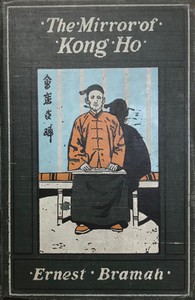
The Mirror of Kong Ho — Reading Notes
(0 User reviews)
421
Project Gutenberg
1997
Not confirmed
Humorous stories; England -- Fiction; Epistolary fiction; Chinese -- England -- Fiction
Readers of public-domain and historical texts
Project Gutenberg digital edition
en
Edition facts
Words
54,879
Reading time
239 min
Text sections
19
The source record for The Mirror of Kong Ho — Reading Notes measures this digital text at 54,879 words, 3 hr 59 min estimated reading time, and 19 detected text sections.
The text analysis averages about 35.7 words per sentence, while the detected sections provide another way to judge how the source is divided.
Project Gutenberg metadata also associates the work with “Humorous stories,” connecting these edition facts with the source record’s subject description.
Source:
Project Gutenberg record #1077
Kong Ho's letters to China dissect London customs through a satirical lens, blending archaic English with precise observations on underground travel, proverbs, and the absurdities of 'barbarian' life.
Read the complete public-domain text at its original source.
Read on Project GutenbergThe Mirror of Kong Ho unfolds as a series of letters from a Chinese gentleman in London to his homeland, each one a meticulous dissection of Western customs. Kong Ho adopts a formal, archaic English that he claims to have 'engraved upon the receptive tablets of my mind,' a voice that both mimics and mocks the language of his hosts. His observations are grounded in specific, often mundane details—such as the operation of underground trains or the meaning of a proverb—which he then expands into broader commentary on the logic (or illogic) of barbarian life. The structure is episodic, each letter a self-contained vignette that moves from a concrete incident to a philosophical reflection, mirroring the epistolary tradition while subverting it with satirical intent.
The Epistolary Frame and the Voice of Kong Ho
The book’s structure is built around letters addressed to an unnamed 'Venerated Sire' in China, a framing device that allows Kong Ho to adopt a tone of patient explanation. He frequently apologizes for his 'immature compositions' and insists on 'undeviating fidelity' to what he has observed, yet his narrative is laced with ironic asides. For instance, he recounts a proverb about not placing 'the carte before the horse,' then spends several paragraphs unpacking its supposed barbaric humor, revealing more about his own cultural assumptions than about the English. This layered voice—deferential yet condescending, earnest yet sly—creates a persistent tension between the narrator’s professed humility and his sharp critique.
Recurring Images: Underground Caverns and Hot-Smoke Chariots
Kong Ho returns repeatedly to the image of the London Underground, which he describes as 'caverns artificially let into the bowels of the earth.' His account of purchasing a 'printed sign' (a ticket) and displaying it to a 'guardian of the gate' transforms a routine commute into a ritual fraught with demonic peril. He confesses his unease about 'the exact connection between the movements of these hot-smoke chariots and the Unseen Forces,' a phrase that conflates technology with superstition. This recurring motif—the barbarian’s reliance on invisible mechanisms—serves as a running metaphor for the opacity of Western society. The underground becomes a symbol of both progress and irrationality, a space where Kong Ho’s careful logic falters.
Movement Between Scenes: From the Capital to the Outskirts
The letters trace a physical journey as well as a cultural one. In one excerpt, Kong Ho explains that he has left the Capital to observe 'the habits of those who dwell in the more secluded recesses on the outskirts of the Island.' This shift in setting is announced with characteristic indirection: he first recounts a proverb about setting the banquet before the horse, then admits he was about to 'record certain details of recent occurrence without first unrolling to your mind the incidents from which it has arisen.' The movement between locations is thus mediated by a digressive narrative style that mirrors the wanderings themselves. Each new scene—whether a palace, a cavern, or a rural retreat—prompts a fresh round of cultural translation.
The Role of Proverbs and Misunderstanding
Kong Ho collects English proverbs as specimens of 'foreign thought and expression,' but his interpretations often reveal more about his own frame of reference. He dissects the saying 'Do not place the carte before the horse' with elaborate pedantry, imagining a 'barbarian emperor' appointing a horse as chancellor. The humor lies in the gap between the proverb’s simple meaning and Kong Ho’s ornate, literal-minded exegesis. Yet he also acknowledges the possibility of misunderstanding: he admits he may 'have misunderstood an involved allusion or failed to grasp the inner significance of an act.' This self-awareness complicates the satire, suggesting that the mirror Kong Ho holds up to English society is itself distorted by the very cultural biases he critiques.
Readers should approach these letters as a performance of cultural translation rather than a straightforward account. Kong Ho’s voice is a deliberate construct, blending Chinese rhetorical forms with a parody of English politeness. The pleasure of the text lies in watching him navigate the gap between what he sees and what he makes of it. Pay attention to the moments where his confidence wavers—those are the cracks through which the real complexity of cross-cultural encounter shines.
I keep returning to Kong Ho’s letters—that precise, half-smiling bewilderment at how we carry ourselves. There’s a similar ache underneath the domestic machinery in The Evil Genius: A Domestic Story — Key Ideas to Explore, where the household becomes its own strange country, with rituals just as unexamined. Both make me wonder what we’d write home about, if we dared to look.
There are no reviews for this eBook.
There are no comments for this eBook.
Reader reflection
How will you remember this book?
Save your reaction, strongest insight, and memorable passage.
Your progress
0
/
10
2
What was your overall reaction to the book?
3
Is this a title you would suggest to others?
4
Did the language feel accessible?
5
How useful were the ideas in this book?
6
Do you expect to return to this book?
7
How strongly did the book affect you emotionally?
8
Did the story or argument move comfortably?
9
Which lesson or insight stayed with you?
10