1

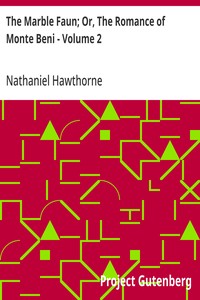
The Marble Faun; Or, The Romance of Monte Beni - Volume 2 — Background and Themes
(0 User reviews)
715
Project Gutenberg
2006
Not confirmed
Psychological fiction; Love stories; Nobility -- Fiction; Rome (Italy) -- Fiction; Artists -- Fiction; Murder -- Fiction; Americans -- Italy -- Fiction; Women art students -- Fiction
Readers of public-domain and historical texts
Project Gutenberg digital edition
en
Edition facts
Words
81,280
Reading time
354 min
Text sections
10
For The Marble Faun; Or, The Romance of Monte Beni - Volume 2 — Background and Themes, the stored edition analysis reports 81,280 words, 5 hr 54 min estimated reading time, and 10 detected text sections.
The text analysis averages about 24.8 words per sentence, while the detected sections provide another way to judge how the source is divided.
Project Gutenberg metadata also associates the work with “Psychological fiction,” connecting these edition facts with the source record’s subject description.
Source:
Project Gutenberg record #2182
Hawthorne's second volume shifts from Rome to the Apennines, tracing Kenyon's visit to Donatello's tower, Hilda's isolation, and the interplay of Catholic ritual and personal conscience through recurring images of towers, doves, and the Campagna.
Read the complete public-domain text at its original source.
Read on Project GutenbergThe second volume of The Marble Faun opens with Kenyon riding to an ancient country house in Tuscany, a setting that immediately signals a shift from the claustrophobic streets of Rome to the open spaces of the Apennines. Hawthorne uses this change of scene to explore the characters' inner landscapes, particularly through the recurring image of towers—Donatello's ancestral tower, Hilda's tower in Rome—which become symbols of isolation and perspective. The narrative moves between these elevated points, contrasting the panoramic views with the characters' limited understanding of their own pasts.
Towers and Vistas
The tower at Monte Beni is more than a setting; it is a structural device. Hawthorne describes it as a place where Kenyon can look toward Rome, and where Hilda, from her own tower, yearns for his return. The parallel is explicit: "O that he were here!" Hilda sighs, while Kenyon feels her hand pulling at a silken cord connected to his heart-strings. These towers frame the characters' emotional distances and their attempts to see beyond their immediate circumstances. The Apennines provide a grand backdrop, but the view is always mediated by the tower's height—a vantage point that offers clarity yet also underscores separation.
The Weight of Remembrance
Hawthorne renders Hilda's homesickness through a striking sensory detail: the remembered smell of dead blossoms from her mother's garden. This fragrance, which comes "freshly to her memory, across the windy sea," triggers a cascade of associations—the white meeting-house, the gold-brown stream, the familiar faces. The passage is notable for its concrete specificity; it does not merely state that Hilda is lonely, but shows her mind returning to a particular flower-bed. This technique recurs throughout the volume, where objects and sensations—a pictured window, a bronze pontiff's benediction—carry emotional weight beyond their immediate presence.
Catholicism as Consolation and Contrivance
In the chapter "Altars and Incense," Hawthorne examines Rome's religious landscape with a mixture of skepticism and fascination. He notes that Catholicism offers "a multitude of external forms" and "cordials" for every human need, yet he also hints at the artificiality of its machinery, which he suggests was forged "either above or below." Hilda's Puritan inheritance makes her both vulnerable and resistant to these consolations. The text does not resolve whether the faith is genuine or a contrivance; instead, it presents the tension between spiritual longing and institutional ritual as an open question, leaving the reader to weigh the seductive power of ceremony against the demands of individual conscience.
Movement Between City and Country
The volume's structure depends on a series of journeys: Kenyon's ride to Monte Beni, the characters' travels through the Tuscan hills, and the eventual return to Rome for the Carnival. These movements are not merely geographical; they correspond to shifts in mood and narrative pace. The crowded, dusty streets of Rome give way to the "wide, grassy margin" of a village street in Hilda's memory, and later to the open Campagna. Hawthorne uses these transitions to vary the texture of the prose, from the claustrophobic intensity of Roman interiors to the expansive descriptions of the Apennine landscape. The reader is constantly aware of the characters' physical displacement as a mirror of their psychological states.
Readers attentive to Hawthorne's use of recurring motifs—towers, doves, the Campagna—will find that these elements do not simply decorate the narrative but structure its emotional logic. The volume rewards careful attention to the way objects and settings accumulate meaning across chapters, often without explicit commentary. This is a work that asks to be read slowly, with an eye for the patterns that emerge from its deliberate, almost architectural, composition.
Reading Hawthorne’s towers and doves drifting over the Campagna, I kept circling back to a quieter kind of solitude—the gentle, stubborn conscience that lives behind closed doors. There’s a warmth in how both authors let silence speak, how faith and doubt occupy the same small room. It reminded me of The Warden — Reading Companion, that same unhurried ache for doing right.
There are no reviews for this eBook.
There are no comments for this eBook.
Reader reflection
How did this book work for you?
Your answers remain private and are stored only in this browser.
Your progress
0
/
10
2
Did this book hold your interest?
3
Would you recommend this book to another reader?
4
How much effort did this book require?
5
How useful did the reading feel?
6
How personally connected did you feel to the book?
7
Was the book easy to understand?
8
Do you expect to return to this book?
9
What did this book teach you most?
10