1

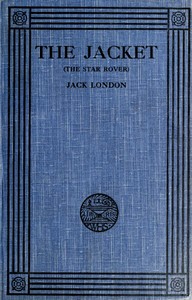
The Jacket (The Star-Rover) — Story, Setting & Ideas
(0 User reviews)
875
Project Gutenberg
1998
Not confirmed
Psychological fiction; Prisoners -- Fiction; Reincarnation -- Fiction; Paranormal fiction; California State Prison at San Quentin -- Fiction; Death row inmates -- Fiction; San Quentin (Calif.) -- Fiction; Astral projection -- Fiction
Readers of public-domain and historical texts
Project Gutenberg digital edition
en
Edition facts
Words
109,271
Reading time
476 min
Text sections
23
The source record for The Jacket (The Star-Rover) — Story, Setting & Ideas measures this digital text at 109,271 words, 7 hr 56 min estimated reading time, and 23 detected text sections.
The text analysis averages about 16.5 words per sentence, while the detected sections provide another way to judge how the source is divided.
Project Gutenberg metadata also associates the work with “Psychological fiction,” connecting these edition facts with the source record’s subject description.
Source:
Project Gutenberg record #1162
Jack London's novel follows a death row inmate at San Quentin who discovers he can access past lives through astral projection while enduring the torturous 'jacket' restraint. The narrative shifts between prison brutality and vivid historical episodes, including a shipwreck in Korea and memories of being a star-rover.
Read the complete public-domain text at its original source.
Read on Project GutenbergThe narrator begins by addressing the reader directly, insisting that everyone carries an awareness of other times and places from childhood. He recalls dreaming of flight and fearing monstrous things, arguing that such memories prove prior existence. This framing immediately establishes the novel's central tension: the clash between material confinement and spiritual transcendence.
The excerpts show two distinct registers. One is the claustrophobic present of San Quentin, where the narrator is subjected to the 'jacket'—a canvas restraint that tortures the body. The other is the expansive past, rendered in sensory detail: the taste of brown rice with husks, the feel of yard-long pipes, the sight of Korean soldiers with matchlocks on tripods. London uses the prison setting to make the case for reincarnation as a form of psychological escape.
The Prison Frame and the Astral Escape
The jacket of the title is a literal straitjacket used on death row inmates. The narrator describes being laced into it for hours, the canvas squeezing his chest and cutting off circulation. Yet this very constraint becomes the catalyst for his out-of-body experiences. He learns to leave his body behind, traveling through time and space while his physical form remains locked in place.
London draws a direct line between the intensity of suffering and the vividness of the visions. The more the jacket tightens, the further the narrator roves. This creates a paradoxical dynamic: the prison is both the source of his torment and the engine of his liberation. The narrative structure mirrors this, cutting abruptly from the present ordeal to a past life as a Dutch sailor shipwrecked on the Korean coast.
The historical episodes are not mere fantasies; they carry their own weight of physical detail. The narrator remembers the exact feel of a Korean fishing boat, the taste of milky brew that made him 'singing drunk,' and the texture of earthen-walled houses. These memories are as concrete as the prison walls, suggesting that the past is not less real than the present.
Colonial Encounters and Uneasy Mastery
One extended memory places the narrator among a crew of Dutch sailors—'sea-cunies'—who are shipwrecked on an island off Korea. London portrays the encounter with a mixture of ethnographic curiosity and colonial arrogance. The sailors dismiss the Korean fishermen as 'miserable fishers' and 'a poor and wretched folk,' yet they are entirely dependent on them for rescue and hospitality.
The description of the Korean noble Kwan Yung-jin is particularly telling. He arrives in 'pale-tinted silks of various colours,' surrounded by attendants, and is identified as a 'yang-ban' and 'tithe-squeezer or tax-farmer.' The narrator's tone is neutral, but the details accumulate into a portrait of a stratified society. The soldiers carry matchlocks so heavy that two men are needed to operate one, and the narrator notes dryly that 'sometimes the gun went off.'
This section of the novel complicates any simple notion of European superiority. The sailors are loud, drunk, and ignorant; the Koreans are organized, resourceful, and patient. London uses the historical setting to explore themes of cultural contact and misunderstanding, without reducing either side to caricature.
The Texture of Memory: Sensory Detail as Evidence
London's prose in the past-life sequences is remarkably tactile. The narrator does not simply recall events; he recalls the physical sensations associated with them. He remembers the 'brown as chocolate' rice with 'bits of chaff, splinters, and unidentifiable dirt' that made him pause to pick debris from his teeth. He remembers the 'mild and tasteless tobacco' smoked in 'tiny bowls at the end of yard-long pipes.'
These details serve a dual purpose. On one level, they make the past lives feel more real than the present, which is often described in abstract terms of pain and confinement. On another level, they function as evidence for the narrator's claim that memory is experience. If he can recall the exact texture of Korean rice, then perhaps he truly lived that life.
The sensory richness also contrasts with the blankness of the prison cell. The jacket strips the narrator of movement and sensation; the memories restore it in abundance. London seems to suggest that the body, even when imprisoned, can be a gateway to other worlds—if one knows how to read its deepest impressions.
Readers should pay close attention to the shifts in narrative voice. The opening chapters establish a philosophical argument for reincarnation, but the later sections abandon argument for direct experience. The novel does not resolve the tension between the two; instead, it lets the reader inhabit both the prison and the past simultaneously. The jacket is never far away, even when the narrator is roving the stars.
That rainy afternoon, I finished The Jacket feeling hollowed out by its prison walls, yet oddly weightless from Darrell Standing’s long escapes. My mind lingered on chance—how one brutal twist yields another life entirely. Later, idly, I picked up Chance: A Tale in Two Parts — Edition Insights and found the same quiet ache of unforeseeable turns, told differently, softer around the edges. One book simply handed me the next.
There are no reviews for this eBook.
There are no comments for this eBook.
Reader reflection
How did this book work for you?
Your answers remain private and are stored only in this browser.
Your progress
0
/
10
2
What was your overall reaction to the book?
3
How likely are you to recommend this book?
4
How much effort did this book require?
5
Was the book what you thought it would be?
6
Was the book easy to understand?
7
Did you gain anything practical from the text?
8
How much did the book move you?
9
In one sentence, what did you learn?
10