1

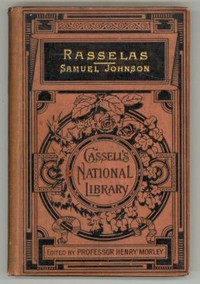
Rasselas, Prince of Abyssinia — Reading Notes
(0 User reviews)
875
Project Gutenberg
1996
Not confirmed
Satire; Princes -- Fiction; Happiness -- Fiction; Ethiopia -- Fiction
Readers of public-domain and historical texts
Project Gutenberg digital edition
en
Edition facts
Words
41,122
Reading time
179 min
Text sections
4
The catalog record for Rasselas, Prince of Abyssinia — Reading Notes provides practical reading context through 41,122 words, 2 hr 59 min estimated reading time, and 4 detected text sections.
The text analysis averages about 25.4 words per sentence, while the detected sections provide another way to judge how the source is divided.
Project Gutenberg metadata also associates the work with “Satire,” connecting these edition facts with the source record’s subject description.
Source:
Project Gutenberg record #652
Samuel Johnson's philosophical tale follows Prince Rasselas and his sister Nekayah as they escape a utopian valley to examine human happiness through conversations with various characters, revealing the limits of choice and the persistence of discontent.
Read the complete public-domain text at its original source.
Read on Project GutenbergSamuel Johnson wrote Rasselas, Prince of Abyssinia in the evenings of a single week in 1759, earning a hundred pounds to cover his mother's burial debts. The narrative begins in the Happy Valley, a secluded paradise where the prince grows restless despite having every wish gratified. Johnson's prose is measured and aphoristic, often compressing moral insight into balanced clauses. The opening chapters establish a pattern of inquiry: Rasselas observes the valley's inhabitants, finds their contentment superficial, and resolves to escape in pursuit of a better life. The story that follows is less a novel of action than a series of dialogues and vignettes, each testing a different theory of happiness.
The Happy Valley as a Starting Point
The Happy Valley is described as a place where "every desire was immediately granted" and "all the blessings of nature were collected." Yet Rasselas finds this abundance oppressive: he complains that "I have already enjoyed too much; give me something to desire." Johnson uses the valley to frame a central paradox—that perfect ease produces not contentment but ennui. The prince's restlessness is not a flaw but a philosophical necessity; it drives him to seek knowledge of the world. The valley's isolation also introduces the theme of choice: Rasselas must decide to leave, and that decision sets the entire inquiry in motion. Readers should note how Johnson contrasts the valley's artificial perfection with the imperfect, varied world outside.
Conversations as the Engine of Inquiry
Once Rasselas and his sister Nekayah escape, the narrative proceeds largely through structured conversations. They visit a hermit, a philosopher, a wealthy man, and others, each representing a different claim to happiness. Johnson does not dramatize these encounters; instead, he presents them as debates. For instance, the philosopher who teaches that "reason alone can secure happiness" is later found grieving his daughter's death, exposing the limits of rational self-sufficiency. Nekayah emerges as a sharp interlocutor, challenging her brother's assumptions. In one exchange, she argues that virtue does not guarantee visible happiness, noting that "all natural and almost all political evils are incident alike to the bad and good." These dialogues are the book's core method: they test ideas through argument rather than plot.
The Role of Marriage and Domestic Life
In Chapter XXVIII, Rasselas argues that marriage is "evidently the dictate of Nature" and a likely means of happiness. Nekayah counters with a more skeptical view, pointing to the miseries of ill-suited unions. This exchange is typical of the book's balanced structure: each position receives a reasoned defense, but no final resolution is offered. Johnson does not endorse either view; instead, he lets the debate stand. The discussion of marriage also reflects the broader theme of choice under uncertainty. Rasselas wants to believe that a single decision—whom to marry—can secure happiness, while Nekayah insists that life's complexities resist such simple solutions. Readers should attend to how these conversations accumulate without reaching a definitive conclusion.
The Limits of Human Speculation
Late in the excerpts, Rasselas warns against "exaggeratory declamation" that imagines catastrophes rarely encountered. He urges focus on "domestic evils" and the ordinary business of life: "the smith still plies his anvil and the husbandman drives his plough forward." This passage is a key to Johnson's method: he grounds philosophical inquiry in everyday experience. The book does not offer a system but a series of checks on overambitious thinking. Rasselas and Nekayah never find the perfect life they seek; instead, they return to Abyssinia with a more modest understanding. Johnson's conclusion is famously open-ended: "they resolved, when they had obtained the blessings of heaven, to return to Abyssinia." The reader is left to judge whether this is wisdom or resignation.
Rasselas rewards a patient reading that follows the arguments rather than the plot. Johnson's sentences are dense and often ironic; a single line can overturn a chapter's reasoning. Because the book was written quickly and never revised by its author, some transitions feel abrupt, but this haste also gives the prose a conversational energy. Readers may find it useful to track each character's position as it evolves, noting where Johnson leaves contradictions unresolved. The work is best approached as a dialogue on human limitation, not a story with a moral.
Rasselas and his sister wandered seeking happiness, much as I once wandered through The Yates Pride: A Romance, finding only that choice’s restless murmur follows us everywhere. Both books whisper a familiar truth—discontent is a patient companion. I recall that quiet realization settling over me like evening dust. The Yates Pride: A Romance — Story, Setting & Ideas holds a similar, gentle ache.
There are no reviews for this eBook.
There are no comments for this eBook.
Reader reflection
Before you leave, reflect on the book
Use these questions to collect your thoughts before moving on.
Your progress
0
/
10
2
Did this book hold your interest?
3
Would you recommend this book to another reader?
4
How demanding did the text feel?
5
Did you relate to its people, ideas, or situations?
6
How useful were the ideas in this book?
7
Was the book moving at the right speed?
8
How would you rate its originality?
9
In one sentence, what did you learn?
10