1

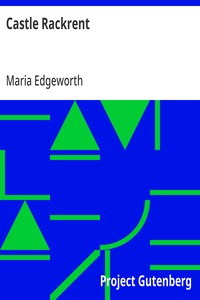
Castle Rackrent — A Closer Reading
(0 User reviews)
332
Project Gutenberg
2006
Not confirmed
Domestic fiction; Landlord and tenant -- Fiction; Poor families -- Fiction; Pastoral fiction; Ireland -- Social life and customs -- Fiction; Ireland -- Fiction; Landowners -- Fiction; Rich people -- Fiction; Rural conditions -- Fiction; Administration of estates -- Fiction
Readers of public-domain and historical texts
Project Gutenberg digital edition
en
Edition facts
Words
49,194
Reading time
214 min
Text sections
8
The source record for Castle Rackrent — A Closer Reading measures this digital text at 49,194 words, 3 hr 34 min estimated reading time, and 8 detected text sections.
The text analysis averages about 30.4 words per sentence, while the detected sections provide another way to judge how the source is divided.
Project Gutenberg metadata also associates the work with “Domestic fiction,” connecting these edition facts with the source record’s subject description.
Source:
Project Gutenberg record #1424
Maria Edgeworth's 1800 novel, narrated by the loyal steward Thady Quirk, chronicles the decline of the Rackrent family through four generations of Irish landlords. The excerpts reveal a tale of mismanagement, marital discord, and shifting power, told in a distinctive vernacular voice that blends comic observation with social critique.
Read the complete public-domain text at its original source.
Read on Project GutenbergFrom the first page, Maria Edgeworth's Castle Rackrent establishes an unusual narrative voice: the story is told not by an omniscient author but by Thady Quirk, an elderly steward who speaks in a dense Irish vernacular. His opening words—'Having, out of friendship for the family, undertaken to write the history of the Rackrents'—immediately signal a partisan, intimate perspective. The reader is plunged into a world where family loyalty and personal interest are tightly interwoven, and where the narrator's affection for his masters coexists with a sharp, often ironic awareness of their follies.
The excerpts also introduce the novel's layered structure: the main narrative is framed by an author's preface, editorial footnotes, and a glossary, all of which create a deliberate distance between Thady's voice and Edgeworth's own. This editorial apparatus invites the reader to question the reliability of the steward's account and to consider the broader social and historical forces at play in late eighteenth-century Ireland.
Thady's Voice and the Steward's Perspective
The excerpts showcase Thady's distinctive speech patterns, which blend colloquial Irish idioms with a formal, almost legalistic tone when describing family affairs. He refers to his masters with deferential epithets like 'my poor master' and 'God bless him!', yet his narration is peppered with shrewd observations about their behavior. For instance, when Sir Condy's wife objects to whisky-punch, Thady recounts the scene with a butler 'going backwards and forwards unnoticed with the jug'—a detail that underscores his own role as an unobtrusive witness to domestic drama.
Thady's language is also marked by a tendency to understate conflict. He describes Sir Condy's debts and the family's decline with a matter-of-factness that contrasts with the chaotic events he relates. This narrative stance creates a tension between the steward's professed loyalty and the reader's growing awareness of the Rackrents' mismanagement. Edgeworth's use of a first-person, lower-class narrator was innovative for its time, and the excerpts demonstrate how Thady's voice shapes the reader's understanding of the story.
Marriage, Money, and Miscommunication
A central episode in the excerpts involves the marriage of Sir Condy Rackrent and his wife Bella. The scene is built around a misunderstanding over whisky-punch: Bella claims she never smelled it before marriage, while Sir Condy recalls she liked it well enough. This trivial object becomes a flashpoint for deeper grievances about love, honesty, and financial expectations. Bella's accusation that Sir Condy is 'ungrateful, base, barbarous' and her subsequent fit of hysterics reveal the fragility of their union.
The passage is notable for its use of indirect reporting—Thady learns the details from Mrs. Jane, the lady's maid—which adds layers of hearsay and interpretation. The dialogue, rendered in a naturalistic style, captures the couple's inability to communicate: Sir Condy's attempts at conciliation are clumsy, and Bella's emotional outbursts escalate the conflict. Edgeworth uses this domestic quarrel to illustrate broader themes of economic dependency and social performance, as the marriage is also a financial arrangement meant to restore Castle Rackrent's fortunes.
The Rackrent Legacy: Decline and Debt
Throughout the excerpts, the Rackrent family's financial troubles are a constant undercurrent. Thady mentions that Sir Condy's debts were supposed to be paid by his father-in-law, and that tradesmen gave 'new credit' after the wedding. Yet the narrative hints at ongoing extravagance: Bella's 'fine taste for building, and furniture, and playhouses' and her transformation of the barrack-room into a theatre suggest a pattern of spending beyond means. The phrase 'as if she had a mint of money at her elbow' underscores the illusion of wealth that sustains the family's social standing.
The novel's structure, as indicated by the table of contents, traces the 'History of Sir Conolly Rackrent' and earlier generations, implying a long arc of decline. The excerpts do not reveal the ultimate fate of the estate, but they establish a pattern of mismanagement and denial. Thady's role as steward—a position that gives him intimate knowledge of the family's finances—makes his narrative a unique record of how the Rackrents' lifestyle outstripped their resources. The reader is left to piece together the economic realities behind the steward's loyal account.
Editorial Framing and Historical Context
The excerpts include an introduction by Anne Thackeray Ritchie, which provides biographical and historical context for Edgeworth's work. Ritchie describes the Edgeworth family's 'unconventional and spirited' tradition and notes the existence of 'passionately eloquent letters' from ancestors. This framing situates Castle Rackrent within a specific Anglo-Irish milieu, where family history and local politics were deeply intertwined.
Edgeworth's own author's preface and the glossary that accompanies the novel further complicate the reading experience. The glossary explains terms like 'whisky-punch' and 'barrack-room,' suggesting that Edgeworth anticipated a non-Irish audience. The footnotes, which are referenced in the excerpts, add another layer of commentary, often correcting or expanding on Thady's statements. This editorial apparatus invites the reader to consider the novel as both a work of fiction and a document of social history, blending the steward's subjective account with objective annotation.
As you read Castle Rackrent, pay close attention to the gaps between what Thady says and what he implies. His loyalty to the Rackrents is genuine, but his narrative often reveals more than he intends. The footnotes and glossary are not mere supplements; they are integral to Edgeworth's project of creating a layered, ironic portrait of Irish landlordism. Let the steward's voice guide you, but keep one eye on the editorial frame—it is there that the novel's deeper critique takes shape.
Thady’s voice made me think of my grandfather’s way of telling family stories—half pride, half quiet mourning for what we let slip away. Reading about the Rackrents’ ruin felt like sitting in his kitchen, hearing the same old warnings. The Ambassadors — Themes and Context once gave me that same ache about missed chances, though there it was all in the silences of careful men.
There are no reviews for this eBook.
There are no comments for this eBook.
Reader reflection
What did you think of this book?
Answer a few questions and save a private reflection on this device.
Your progress
0
/
10
2
How did the book work for you overall?
3
Would you encourage someone else to read it?
4
What was the reading difficulty like?
5
Did the book offer a fresh perspective?
6
Would this book work well in a reading group?
7
Is this a title worth rereading?
8
Did the book deliver what you hoped for?
9
What changed or sharpened your thinking?
10