1

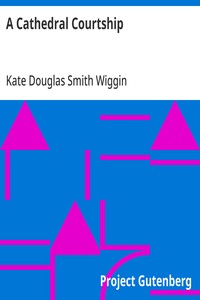
A Cathedral Courtship — Background and Themes
(0 User reviews)
187
Project Gutenberg
1998
Not confirmed
Love stories; Diary fiction; Americans -- England -- Fiction; England -- Description and travel -- Fiction
Readers of public-domain and historical texts
Project Gutenberg digital edition
en
Edition facts
Words
12,000
Reading time
53 min
Text sections
2
The catalog record for A Cathedral Courtship — Background and Themes provides practical reading context through 12,000 words, 53 min estimated reading time, and 2 detected text sections.
The text analysis averages about 19.6 words per sentence, while the detected sections provide another way to judge how the source is divided.
Project Gutenberg metadata also associates the work with “Love stories,” connecting these edition facts with the source record’s subject description.
Source:
Project Gutenberg record #1551
A young American woman's diary records her cathedral tour of England with her High Church aunt, where she becomes the object of an architect's affections. The narrative alternates between her candid entries and his letters, revealing a courtship conducted under the chaperon's oblivious eye.
Read the complete public-domain text at its original source.
Read on Project GutenbergThe story unfolds through two alternating voices: Katharine Schuyler's diary entries and the letters of Jack Copley, an architect she meets on a cathedral tour. The opening pages establish a sharp contrast between the narrator's irreverent, self-deprecating tone and her aunt Celia's solemn devotion to High Church ritual and architectural history. Kitty describes herself as a girl who 'is not at all the sort who makes notes,' yet she fills a locked leather journal with observations that undercut her aunt's earnest educational project. The tension between spontaneous feeling and prescribed cultural improvement is set from the first entry.
Two Diarists, Two Registers
The narrative is built on a structural counterpoint. Kitty's entries are spontaneous, colloquial, and often self-mocking: she admits her 'taste is so bad' after admiring a window she later learns is the worst in the cathedral. Jack's letters, by contrast, are calculated and analytical. He describes Kitty as 'the concentrated essence of feminine witchery' and dissects her character with the precision of a man accustomed to drawing plans. Where Kitty records impressions, Jack strategizes. This dual perspective allows the reader to see the same events—a service, a walk, a conversation—through radically different lenses.
The diary form itself becomes a subject. Kitty's notebook has a lock and key, suggesting private confidences, yet Jack's letters are also a kind of diary, addressed to an unnamed correspondent. Both narrators are performing self-awareness, but in different keys. Kitty's entries are full of dashes and exclamations; Jack's are more measured, though he confesses his 'wall of reserve is worn to the thinness of thread-paper.' The contrast in voice is not merely stylistic but thematic: it dramatizes the gap between how we experience events and how we later shape them into narrative.
Architecture as a Language of Courtship
Jack Copley is an architect, and his professional eye shapes his approach to romance. He compares Kitty's character to a building: 'will-power large, but docility equal, if a man is clever enough to know how to manage her.' The metaphor is telling—he sees her as a structure to be understood, perhaps even improved. Aunt Celia's dead fiancé was also an architect, a man who 'succeeded in making an imaginary scale-drawing of her heart.' The profession thus becomes a figure for the attempt to map and possess another person.
Kitty, meanwhile, is acutely aware of her own ignorance about architecture. She admires the wrong windows, misuses quotations, and writes a comic ballad about her aunt's excessive tipping of vergers. Her lack of technical knowledge is presented not as a flaw but as a kind of freedom. Jack, for all his expertise, is reduced to writing his feelings on hymn-book fly-leaves (though he refrains). The cathedral setting—with its stone, glass, and ritual—provides a shared vocabulary for their attraction, even as it highlights their different ways of seeing.
The Chaperon Who Sees Everything but the Obvious
Aunt Celia is the comic engine of the courtship. She is described as 'deliciously blind,' so absorbed in antiquity that she 'ignores the babble of contemporaneous lovers.' Jack marvels that she cannot imagine a man looking at Kitty when he could look at a cathedral. This blindness is not mere absent-mindedness; it is a function of her ideological commitment. She believes the tour will 'give me a taste for ritual and bring me into the true fold,' and she treats the itinerary as sacred writ.
Yet the excerpts suggest that aunt Celia is not simply a foil. She has her own history of loss—the young architect who died at twenty-six, leaving only a livery stable and a country hotel as his legacy. Her reverence for cathedrals is intertwined with that memory. Kitty's irreverence, then, is not just youthful high spirits but a challenge to her aunt's entire worldview. The courtship proceeds 'under aunt Celia's very nose' because she is looking elsewhere—at stone, at glass, at the past. The comedy depends on the reader seeing what she does not.
Readers will find that the pleasure of this novella lies less in the outcome of the courtship than in the friction between its two narrative voices. The diary form invites us to compare what Kitty says with what Jack says, and to notice what each leaves out. Pay attention to the small details—the locked notebook, the ballad about vergers, the quoted French inscription on a toy—as they accumulate into a portrait of two people trying to read each other through the medium of cathedrals.
I’ve always found something gentle in how a young American woman’s diary catches the hush of English cathedrals, the way her heart wanders even as her aunt chatters on. That same patient ache lives in Mary Barton — A Closer Reading, where grief speaks softly between the lines of working lives. Both books hold their tenderness like a secret passed from one reader to another.
There are no reviews for this eBook.
There are no comments for this eBook.
Reader reflection
Your personal reading reflection
Build a private reading journal entry for this title.
Your progress
0
/
10
2
What was your overall reaction to the book?
3
How likely are you to recommend this book?
4
How easy was the book to follow?
5
Did the book give you something worth debating?
6
What did you appreciate most?
7
How strongly did the book affect you emotionally?
8
Was the book what you thought it would be?
9
In one sentence, what did you learn?
10