
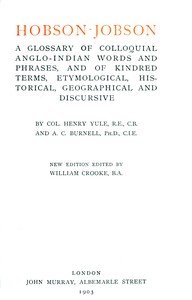
Hobson-Jobson by Sir Henry Yule and A. C. Burnell
Okay, let's be clear: this is not a book with a plot. You won't find heroes or villains in the traditional sense. Instead, Hobson-Jobson is a historical dictionary, a massive collection of Anglo-Indian words and phrases. Its 'story' is the story of language itself. Compiled in the late 19th century by Henry Yule and Arthur Burnell, it captures the words that British soldiers, traders, and officials in India picked up, mangled, and brought back home.
The Story
The book documents hundreds of terms. It explains that 'bungalow' comes from the Gujarati word for a house in the Bengal style. It tells you that 'shampoo' evolved from the Hindi word for a head massage. Each entry is a mini-history lesson, tracing a word from its Indian roots, through its often-botched pronunciation by the British ('Hobson-Jobson' itself is a garbled version of a Muslim cry during festivals), to its place in English. The 'conflict' here is cultural collision, played out not with guns, but with grammar and misunderstanding.
Why You Should Read It
I love this book because it's alive with personality. The authors weren't dry academics; their notes are full of wit, sarcasm, and firsthand anecdotes. You get a real sense of the bustling, confusing, and vibrant world of colonial India. It turns etymology (the study of word origins) into a treasure hunt. You start seeing the history of empire and everyday life hidden in plain sight, in words we use without a second thought.
Final Verdict
Perfect for word nerds, history lovers, and anyone with a curious mind. If you enjoy podcasts about the origins of things or get a kick out of weird facts, you'll find this endlessly entertaining. Don't read it cover-to-cover; dip in and out. It's a book to keep on your shelf and explore one fascinating word at a time. It’s a conversation starter and a window into a world long gone, preserved in the language we speak today.
Legal analysis indicates this work is in the public domain. You can copy, modify, and distribute it freely.
Emily Brown
1 year agoI stumbled upon this title and the emotional weight of the story is balanced perfectly. Truly inspiring.
Deborah Robinson
1 year agoI was skeptical at first, but the depth of research presented here is truly commendable. Truly inspiring.
Melissa Hernandez
1 year agoEnjoyed every page.
Melissa Davis
1 year agoGreat reference material for my coursework.

Amanda Ramirez
2 months agoHonestly, the pacing is just right, keeping you engaged. I would gladly recommend this title.